
What is Pilates?
Pilates is a method of conditioning that was developed by Joseph Pilates in Britain in the early 20th century. Upon his immigration to the United States Joseph Pilates, his wife Clara, and many students continued to develop the work throughout the 20th century and it is continuously evolving. Pilates today incorporates the latest research and adapts to new discoveries in the ever changing fitness and somatic movement fields. Since the beginning Pilates has been utilized by dancers, athletes, women, men, grandparents, and students as way to condition their body into balance. Programs at The Pilates Studio are designed individually and each client will work with his/her instructor to create a program that is appropriate for and addresses all of the goals and challenges he or she may face.
Pilates works with many principles including balance, breath, core support, and alignment. As clients develop a practice at The Pilates Studio in many different ways. Click here for more information about how to get started.
What is the Pilates Apparatus?
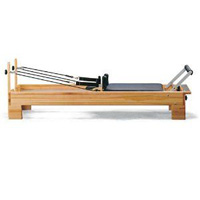 The Reformer uses spring resistance to assist people in some exercises and gives resistance in others. A client at The Pilates Studio can lie down on the Reformer to give the spine added support in exercise, sit on the Reformer so that the body is in position to address upper body strength and shoulder girdle alignment, or stand on the reformer for more advanced exercises that strengthen the body while challenging balance. It is a versatile piece of equipment that can challenge the strongest athlete and support the most injured client in rehabilitation.
 The Trapeze Table/Cadillac supports any rehabilitation process. Springs can add resistance to the legs for strength building or springs can add assistance behind the knees for gentle hip traction. Clients often work to find the mobility in their spine on the Trap table by doing classic Pilates Mat exercises with spring assistance. The Trap table is a great tool to prepare clients for Mat classes, which are often perceived to be harder workouts. The Trapeze Table can also support shoulder girdle strength and alignment through hanging exercises.
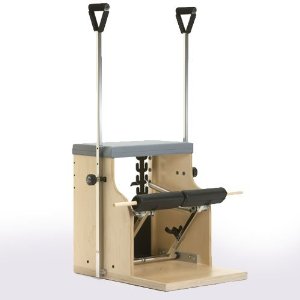 The Chair increases the strength-training component in any Pilates workout. Unlike the Reformer and Trapeze table, the base of support on the Wunda chair is small, so all of the exercises on the Wunda chair require balanced alignment and core support. On the Wunda chair client’s can challenge their balance and increase their strength. It may be small compared to the Reformer or Trapeze Table, but any exercise performed on the chair gives big results.
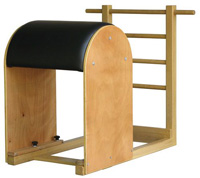 The Ladder Barrel The Ladder Barrel is one of the simpler Pilates apparatus designs, but the exercises on it vary as much as any of the apparatus. The only resistance on the Ladder Barrel is that of gravity acting on the body. Posture is challenged as well as the many muscles that are engaged in activity.
The Pilates Studio also has a plethora of small apparatus that can aid in adding challenges to mat and apparatus workouts.
Progressing a Pilates practice:
The best part of a Pilates practice is that there are no numbers attached. As clients get stronger the progress is measured by activities not the amount of resistance. Once a client who started doing Pilates after a back injury, came into The Pilates Studio very excited. She said “Guess what, on Thanksgiving I pulled a huge Turkey out of the oven and lifted it to the counter by myself.” As a Pilates practice progresses the measures come from life not from numbers. When an exercise gets too easy, an instructor is not going to ask for more repetition, she will give a new exercise, or she will add a proprioceptive challenge (like trying that exercise standing on one leg). Clients are encouraged to notice how their body feels instead of counting repetitions. The Pilates Studio isn’t a gym, and clients aren’t exercising for exercise sake. They are strengthening their bodies and increasing their flexibility so that their lives are better!